

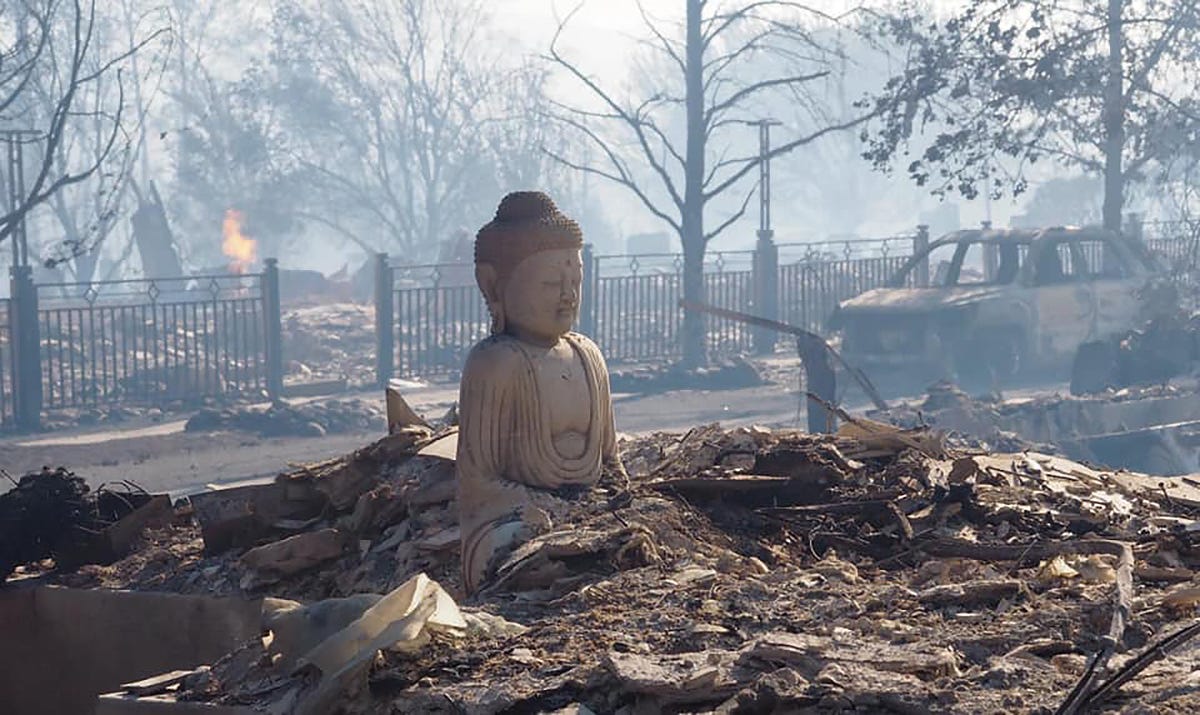
There is a principle older than democracy, older than capitalism, older than most of the religions now invoked to sanctify slaughter: disaster is not uniformly distributed. Someone or something always gains. The question is never only what happened — it is also who or what was positioned to benefit.
But before we follow the money and the power, we need to name what we are actually looking at. Because the usual word people reach for — conspiracy — is the wrong word, and it matters that it’s wrong. Conspiracies require conscious coordination. They require people in rooms, planning together, knowing what they’re doing collectively. What we are looking at, and even though such scenarios are a part of it, does not require any of that. It requires only the consistent, automatic expression of a particular kind of consciousness — one organized around the fundamental experience of a humanity-wide delusional belief in separation. The only belief nearly every human on Earth shares.
Here is the deeper truth that political analysis alone cannot reach, offered without doctrine and without apology: consciousness is the source, the substance, and the animating purpose of everything that exists. Nothing is, or can ultimately be, apart from consciousness. The stars, the coral, the child, the warhead, the banker, the Marine — all of it arising within and as the one thing that truly IS. This is not a belief. It is what the mystics and prophets of every tradition have reported from the inside, and what the leading edges of science keep approaching and reflecting upon from the outside.
But consciousness, arising through the particular instrument of the human animal — with its advanced nervous system, its fearful conditioning or ego, its growing capacity for abstract self-reflection — can, for a while, move into forgetting. Lifetimes. Generations. Millennia. It can become so identified with the seeming separate self, this bounded skin-encapsulated individual, that it loses intuitive and felt connection with the underlying reality of its own original nature. And when that movement deepens into the structures of power — when it is codified into institutions, enforced by armies, consecrated by religions, reproduced through patriarchal hierarchies that reward expanded ideations of separation and punish connection — it becomes what we are looking at now all over our planet.
What the mystics and prophets and awakened ones across every tradition have pointed toward — and what direct experience, when it breaks through, confirms — is that the ground of all this is not neutral. It is not an indifferent void generating worlds for no reason. The ground is love. Not the love that attaches and fears and possesses, but the love that is — the same reality that different fingers have pointed towards with words like consciousness, God, truth, Brahman, Christ, the Tao, the ground of being. Many words. One direction. And that ground, being what it is, does not generate the forgetting accidentally or maliciously. The contraction, the separation, the five-thousand-year run of the beast — all of it arising within and as and from the same love that is the source and substance of everything.
What this means for the movement we are describing — the forgetting, the hardening into hierarchy and domination and war — is not that it is good, or that its victims should accept it, or that resistance is futile. It means something stranger and more radical than any of those: that the recognition which undoes it is not being imported from outside. It is love recognizing itself through the very instruments the forgetting built. The beast does not stand against its own ground. Nothing can. It is also this ground, dreaming a dream of separation, moving — in its own time, by its own logic, beyond any comprehension available to those of us inside the dream — toward waking.
We are inside that movement. We cannot see its full arc. What we can do, from inside it, is name what we see, refuse and resist what we can, and continue to speak and write and act toward this recognition of what we always and already are. All the while trusting, without needing to prove it, that the love which is the ground of all this is also the ground of all we are doing, and of whoever is reached or not, and of whatever wakes through all of it, in whatever time remains.
A consciousness lost in the contractions and identities of separation, as it accumulates what seems to be power, behaves in entirely predictable ways. It acquires. It dominates. It insulates itself from the costs it imposes on others. It converts everything outside the boundary of the self — other people, other nations, the natural world, the future — into resource or threat. It builds hierarchies that protect those at the top from the consequences of their decisions while concentrating the costs at the bottom. And it does all of this not through malevolent genius but through the automatic expression of what it has come to believe it is.
This is the beast we are dealing with. It has been operating through the same basic moves for roughly five thousand years — through pharaohs and Roman senators, through feudal lords and colonial empires, through robber barons and military-industrial complexes, and now through the particular formation of power making decisions about war and peace in Washington, D.C. in 2026.
We have many names for its faces, and all of them are accurate: Capitalism is the economic system through which the separation consciousness organizes the continuous extraction of wealth from labor, earth, and life. Fascism is the political system it builds when that extraction is threatened — the consolidation of power, the elimination of dissent, the merger of corporate and state authority in service of the owning class. Patriarchy is the social and cultural architecture through which it reproduces the hierarchy of domination across generations and genders, encoding the subordination of the relational and the feminine to abstract ideologies and domination. Zionism, in its political-territorial expression, is a specific nationalist instantiation of the same logic — the belief that safety comes through the dispossession and military control of all others. Oligarchy and Autocracy are the class structures that concentrate the gains. Hierarchy is the operating system that runs beneath all of them.
These are not separate beasts. They are facets of the same underlying contraction, expressing itself simultaneously through different institutional forms — economic, political, cultural, national, organizational. When you see them operating together, as they are right now in this war, you are not seeing a conspiracy. You are seeing the full-spectrum expression of a singular consciousness that has forgotten what it is. The actors come and go, the costumes shift and change. The underlying contraction does not. And understanding that this is its nature — not its plan — is what allows us to see it clearly without either the paranoid distortion of conspiracy thinking or the naive reassurance that better people in power would fix it.
Better people in power do not fix it. Consciousness reclaiming Herself from the contraction is what fixes it. And that reclamation begins — it can only begin — with enough people seeing clearly enough what the contraction has been doing in their name.
We are three weeks into a war with Iran that most Americans didn’t vote for, don’t fully understand, and are already paying for at the pump. Two Substack analyses published this week by the Military Innovation Lab’s National Security Desk — “The Predictable Pearl Harbor” and “Kharg Island Is a Suicide Mission for the USMC” — lay out the military picture with the kind of cold precision that official Washington has apparently lost the capacity or the will to provide. Both are exceptionally well-sourced, grounded in confirmed reporting and declassified documents, and written to intelligence community analytical standards. Both are, in the most important respects, correct.
But they stop where the hardest question begins.
They document the catastrophe that may be coming. They do not ask, with sufficient ferocity, who that catastrophe serves — and why that service is not accidental, but structural, and structural for reasons that go all the way down.
That is the question this piece takes up.
First: What the Intelligence Actually Shows
Before following the power, it is worth establishing what the military analysts have confirmed, because the picture is genuinely alarming and the public is largely unaware of it.
At home: Between March 9 and 15, custom-built, jamming-resistant drones flew in waves over Barksdale Air Force Base in Louisiana — the headquarters of Air Force Global Strike Command, one of only two bases in the continental United States that house B-52H nuclear bombers, actively launching combat sorties against Iran. The drones came in organized waves of 12–15 aircraft, maneuvered deliberately over sensitive areas of the flight line, and were explicitly designed to evade location of the operators. A confidential briefing obtained by ABC News concluded the aircraft showed “advanced knowledge” of signal operations and that the operators were “testing security responses.” Former Deputy Assistant Secretary of Defense Mick Mulroy:
“It looked like this was deliberate and intentional to see just how they would react.”
No arrests. No recovered drones. No attribution. As of this writing, the B-52Hs are still on an open flight line with no permanent counter-drone protection.
Simultaneously, unidentified drones overflew Fort McNair in Washington, D.C. — the waterfront installation where Secretary of State Marco Rubio and Secretary of Defense Pete Hegseth both currently live, the fourth and sixth officials in the presidential line of succession. A White House meeting was convened. As of March 21, neither has moved.
The DoD Inspector General’s January 2026 report found that most U.S. military installations — including nuclear bomber bases and the shipyards that build nuclear submarines — lack legal authority to use counter-drone equipment even where that equipment exists. The Air Force did not begin developing counter-drone tactics until January 2026. It posted its first industry solicitations for counter-drone technology on March 6 — three days before the Barksdale swarm began. The battle lab assigned to develop a counter-drone Standard Operating Procedure will not complete its first SOP until the end of 2026.
The B-52 was last built in 1962. The B-2 in 1997. The B-1B in 1988. America cannot replace what it loses.
The Ukraine precedent that was ignored: On June 1, 2025 — nine months ago — Ukraine’s Security Service destroyed approximately one-third of Russia’s strategic bomber fleet in a single night using $234,000 worth of commercially-derived FPV drones concealed in cargo trucks and launched from inside Russian territory. The Norwegian Defence Research Establishment called it “the most successful and devastating attack ever carried out against Russian bomber bases.” Russia immediately relocated its remaining bombers, began constructing hardened shelters at 14 airfields, and deployed air defense systems to every major bomber base. The United States, watching in real time, hardened nothing.
In the Strait of Hormuz: The strait is effectively closed. The IEA has called the disruption “the greatest global energy security challenge in history” and “the largest supply disruption in the history of the global oil market.” Tanker traffic through the Strait itself has collapsed by 92–97% — from roughly 24 vessels transiting daily before the war to a near-total halt, with the handful still moving mostly Iranian-flagged. Global shipping beyond the Strait is severely disrupted: Maersk and Hapag-Lloyd have suspended Mideast routes entirely, bypass routing around the Cape of Good Hope adds weeks and enormous cost to every cargo, and bypass ports in Oman that could partially relieve the choke have themselves been struck by Iranian drones. More than 21 merchant vessels have been attacked. Brent crude has hit $126 per barrel at peak and currently trades around $112. If the closure holds three months, Fitch Ratings projects prices averaging $100/barrel with a spike to $130. Six months: an average of $120 with a spike to $130–170. Wood Mackenzie says $150 is near-term plausible. Analysts are openly discussing $200.
And into this environment, the Trump White House is reportedly considering sending 4,000–5,000 Marines on amphibious ships through the Strait and 300 miles up the Iranian coast to seize Kharg Island — the source of 90 percent of Iran’s oil exports.
“If we take Kharg Island, they will shut off production on their end. We don’t control their oil output.” — Rear Admiral Mark Montgomery
The National Security Desk’s verdict, across 15,000 words of operational and strategic analysis, is categorical: it is a suicide mission. The Strait is a purpose-built kill environment — mines, swarm boats, ballistic anti-ship missiles with Mach 3+ terminal velocity, aerial drone saturation, tunnel-protected fast-attack craft, and a three-power intelligence architecture in which Russia senses, China illuminates, and Iran fires. Even if the Marines survive the transit — which the analysis considers unlikely — they arrive on an island Iran can destroy from the mainland in minutes, breathing in a petrochemical inferno, 15 nautical miles from a hostile coast that can bombard every square meter indefinitely.
“The United States is not choosing to seize Kharg. It is choosing to enter the only battlespace in the world where an amphibious force is guaranteed to suffer cumulative attrition before it reaches the objective.”
The Nature of the Thing That Profits
Now we can follow the power. But the first thing to establish — the thing the military analysts don’t say, because it’s not their genre — is that what we’re about to describe is not a series of cynical choices made by bad actors. It is the automatic behavior of a contracted consciousness operating according to its own internal logic — one that has mistaken the accumulation of power and the elimination of threat for the security it cannot find within itself, because it has lost felt contact with the love that is its own ground.
The separation consciousness doesn’t sit down and decide to profit from catastrophe. It is simply oriented, at every level and in every institution it inhabits, toward the consolidation of power and the insulation of those who hold it from the consequences they impose on everyone else. When catastrophe comes, that orientation expresses itself automatically, the way water finds its level.
This matters because it determines what kind of response can actually work. You cannot appeal to the conscience of a system organized, at its root, against conscience — not out of malice, but out of that loss of contact. You cannot reform it from the inside when the inside is the problem. You can only name it clearly enough, often enough, and loudly enough — building the wider awareness that sees the game for what it is — until the ground shifts beneath it.
With that established: here is how the board is built, and here is which way the pieces move.
The Price of Oil Is a Transfer of Wealth
Begin with the most direct mechanism, because it requires no theory at all — only arithmetic.
Oil at $108–126 per barrel, and potentially $150–200 if the closure extends, is not a shared misfortune. It is an enormous upward transfer of wealth from everyone who consumes energy — that is, everyone — to everyone who owns energy assets. The separation consciousness that runs the energy sector did not plan the Iran war to spike oil prices. It simply finds, when the war happens, that the spike is excellent for its portfolio, and acts accordingly. The difference between $63/barrel (the pre-war forecast) and $112, across global daily consumption of roughly 100 million barrels, is approximately $4.9 billion per day flowing to the ownership class above what would have flowed in peace. Every day the Strait stays closed, that transfer continues.
The working family in southern Oregon paying $4.50 a gallon is not in a conspiracy with ExxonMobil. ExxonMobil is not in a conspiracy with the war planners. They are all operating according to the logic of a system built around the accumulation of wealth by those who already have it, at the expense of those who don’t.
The fertilizer cascade makes this concrete. Roughly one-third of global fertilizer trade transits the Strait of Hormuz. Fertilizer prices have already jumped from $475 to $680 per metric ton — a 43% increase hitting the spring planting window for corn and soy across the Midwest right now. That input cost runs through to food prices in approximately six to nine months: higher grocery prices in the fall, for food-insecure families, fixed-income retirees, the working poor who spend the highest proportion of their income on food and energy.
Pharmaceutical supply chains transit the Strait. Electronics components. Aluminum, steel, plastics, rubber, sugar. Goldman Sachs has raised its 12-month recession probability to 25%; a Wall Street Journal survey of 50 economists puts the average recession prediction at 32% and rising. A recession, in the world as it is currently organized, is an asset acquisition opportunity for the ownership class — the periodic moment at which those with capital reserves buy at distressed prices what those without capital reserves are forced to sell. This is not a plan. It is gravity.
The Burning World: Oil, War, and the Climate the Beast Is Leaving Behind
There is a dimension to this war that the military analysts don’t address and the financial analysts largely bracket: we are fighting over the resource that is destroying the planet’s capacity to support human civilization and the natural world as we know it. And that fact is not incidental to the analysis of who profits. It is the ultimate expression of the separation consciousness — the final, most complete form of insulation from consequence — because the consequences are being transferred not just to the poor, not just to the working class, not just to future voters, but to every living thing on earth, across every generation that will ever exist.
The physics is not in dispute and hasn’t been for decades. The carbon dioxide and methane released by burning fossil fuels trap heat in the atmosphere. That trapped heat is already driving the destabilization of every major climate system — accelerating ice melt, raising sea levels, intensifying storms, expanding drought, shifting agricultural zones, bleaching coral reefs, and triggering feedback loops that, once activated, operate beyond any human ability to stop them. The IPCC has been issuing increasingly urgent warnings since 1990. ExxonMobil’s own scientists documented this internally in the 1970s — and the company spent the following four decades funding the think tanks, the politicians, and the manufactured doubt that have delayed meaningful action by a couple of generations.
The separation consciousness does not experience the consequences of its extraction. It experiences the profit. The oil executive whose children will inherit a destabilized climate, the senator funded by fossil fuel money who blocks climate legislation, the shareholder collecting dividends from the company that knew — they are all operating from within the same contraction, the same inability to experience the web of consequence they are part of. They are not monsters. They are the logical product of a system that rewards the extraction of present value from future life.
And now this war has placed the entire architecture of that system in sharp relief. Every barrel of oil burned produces approximately 0.43 metric tons of CO2 — nearly three times the weight of the oil itself, because combustion pulls oxygen from the atmosphere into each CO2 molecule, converting a 300-pound barrel into nearly 950 pounds of greenhouse gas. The 20 million barrels per day that normally transit the Strait, if burned, produce roughly 8.6 million metric tons of CO2 equivalent per day. The global oil market, at full operation, produces approximately 15 billion metric tons of CO2 per year — the single largest driver of the climate breakdown already underway. The war to keep that oil flowing is, from one angle, a war against the planet’s future. And it is profitable, in the near term, for exactly the same people and formations that have blocked climate action for fifty years.
War itself is also one of the largest and least discussed contributors to greenhouse gas emissions. The US military is among the world’s largest institutional emitters — consuming approximately 77–85 million barrels of fuel per year in peacetime operations alone. A single B-52H, currently launching sorties over Iran from Barksdale and RAF Fairford, burns approximately 3,300 gallons of jet fuel per hour. The carrier strike groups, the amphibious ready groups, the Patriot batteries, the HIMARS launchers, the supply chains that sustain them across oceanic distances — all of it runs on fossil fuel, all of it releases carbon, all of it contributes to the heating of an atmosphere already displacing tens of millions of people.
The Iraq War, estimated across its full duration and aftermath, released between 141 million and 600 million metric tons of CO2 equivalent. The burning of oil fields — as happened in Kuwait in 1991, as could happen at Kharg Island — releases carbon at rates that dwarf industrial emissions. The ecological devastation of modern warfare — depleted uranium in soil, chemical contamination of water tables, the destruction of forests and wetlands and agricultural land — is a form of climate damage that accumulates across decades with no accounting in any treaty or budget.
None of this appears in the profit-and-loss calculations of the defense industry or the energy sector. It is externalized — transferred, without consent or compensation, to the living world and to every human being who will inhabit it after the current ownership class is gone. This is the separation consciousness at its most complete: extracting present profit from a future it will not live to experience, insulated by wealth and power and the brevity of individual lives from the full weight of what it is doing.
The climate crisis and the wars over oil are not separate problems with separate causes requiring separate solutions. They are the same problem. They share the same root — the same contracted consciousness that converts the living world into resource, insulates those at the top from the consequences of that conversion, and uses the sacred narratives of nation, security, and economic necessity to make the conversion unchallengeable. You cannot solve the climate crisis without confronting the separation consciousness. You cannot confront the separation consciousness without naming what it has built: capitalism, fascism, patriarchy, zionism, oligarchy, autocracy, hierarchy — and the specific way these systems, in concert, are currently choosing to fight a war over the fuel that is burning the world rather than doing the one thing that might actually preserve a livable world: leaving the oil in the ground.
The Defense Industry: The Catastrophe and the Remedy Are the Same Ledger
Every Patriot interceptor fired at an Iranian Shahed drone in the Gulf costs approximately $3–4 million. The drone it intercepts costs $20,000–35,000. The exchange ratio is roughly 100-to-1 in favor of Iran’s budget and against the American taxpayer — and directly in favor of Raytheon/RTX, which manufactures Patriots and cannot currently produce them fast enough to replenish stocks. War, for Raytheon, is the product line.
This is not a conspiracy. It is the structure of an industry whose business model requires threat. The defense industry does not manufacture security. It manufactures the response to insecurity — and it has every incentive, structural and financial, to ensure that the insecurity continues. The institutional failure to harden American bases against drone attack — years of congressional warnings ignored, the Battle Lab not standing up until 2026, the legal authority for counter-drone engagement still unresolved — is not simply bureaucratic incompetence. It is the operating environment in which the industry extracts maximum value from crisis procurement.
The companies that profit most from the vulnerability are the same companies contracted to fix it. The Palmdale facility that builds B-21 bombers and repairs B-2 stealth damage — the single most consequential building in the American defense industrial base — does not have confirmed legal authority for counter-drone engagement, per the DoD IG report. This seems paradoxical until you understand how the system actually works: Northrop Grumman does not need the facility protected from attack in order to profit from the threat of attack. What it needs is the threat to remain credible and urgent — because credible, urgent threat is what moves emergency contracts, bypasses competitive bidding, and produces exactly the kind of $4.5 billion agreement to increase B-21 production by 25 percent that Northrop Grumman just received. A facility that gets attacked becomes a crisis requiring emergency procurement. A facility that remains technically unprotected remains a justification for perpetual spending. The catastrophe and the remedy are different line items in the same ledger — and the ledger belongs to the same people either way.
The Fascist Ratchet: Emergency as Governing Condition
Authoritarianism is not, at its root, a political program. It is the political expression of the separation consciousness taken to its logical conclusion: a small group of people, experiencing themselves as fundamentally apart from and above the rest of humanity, organizing the full apparatus of the state to protect their position and eliminate whatever threatens it. Democracy — with its insistence on the equal weight of each human life in the determination of collective decisions — is the direct structural antagonist of that consciousness. It must be dismantled, not because any individual authoritarian necessarily plans its dismantlement, but because the separation consciousness, when it holds power, automatically moves to eliminate the constraints on its own operation.
The Trump administration is already at the outer limit of constitutional norms — purging independent military officers, dismantling oversight agencies, centralizing executive authority in a small coterie of loyalists aligned with the oligarchical ownership class. What it has not yet achieved is the legitimation that makes this consolidation permanent and publicly acceptable. For that, it needs what every authoritarian project has eventually needed: a genuine national security emergency that makes democratic deliberation feel like a luxury, dissent feel like treason, and consolidated executive power feel like protection.
After Pearl Harbor, Japanese Americans were put in internment camps with broad public support. September 11 produced the PATRIOT Act, the surveillance state, the Authorization for Use of Military Force still being invoked a quarter century later — none of it requiring meaningful congressional deliberation once the towers fell. The emergency creates the permission structure. The permission structure outlasts the emergency. The next emergency inherits an expanded permission structure. This is the ratchet, and it has been tightening for decades.
A drone attack on Barksdale that kills personnel or destroys irreplaceable B-52s would produce within 48 hours the political conditions for emergency executive authority that bypasses Congress, permanent surveillance infrastructure embedded in civilian airspace, the criminalization of dissent from the war effort, and defense spending levels that make the post-9/11 surge look modest. The fascist project does not require engineering the disaster. It requires only being positioned to use what the disaster produces.
There is a specific, near-term date that concentrates all of this: November 2026. The midterm elections are the last constitutionally available mechanism for any meaningful check on the consolidation underway — all 435 House seats and 35 Senate seats on the ballot, with Republicans currently controlling both chambers. This war provides tools to either win those elections or make them irrelevant.
A decisive-seeming victory before November — the Strait reopened, the Iranian nuclear program eliminated, oil prices dropping — would produce the classic rally effect: a wartime president who accomplished what four previous presidents only promised is not easily defeated at the midterms. The administration is banking on exactly this, with Trump allies privately pushing for clearer victory messaging and a defined endpoint before the economic pain becomes permanent. But that path is narrowing. The war is already polling badly — nearly 60% of Americans disapprove — and a significant fracture has opened within the MAGA coalition itself, with major MAGA voices condemning the war as a betrayal of America First principles. A prolonged conflict risks becoming what Republican congressman Thomas Massie predicted on the House floor: “A war is never more popular than it is on the first day.”
Which is precisely where the other path becomes more attractive to the authoritarian project. On the morning the bombs began falling — 4:35 a.m., February 28 — Trump posted to Truth Social that Iran had tried to interfere in the 2020 and 2024 elections. Weeks earlier, he had told a right-wing podcaster that Republicans should “nationalize” voting in at least 15 states in 2026. The connection between the war and the vote was not incidental. It was announced. A war predicated on Iranian election interference provides the exact legal and political architecture for what the authoritarian project most needs: a national security justification for federalizing election administration, suppressing turnout in Democratic districts under the banner of wartime security, and delegitimizing any result that goes the wrong way as enemy-influenced.
The incentive structure rewards either decisive triumph or permanent emergency — and the authoritarian project has positioned itself to extract maximum benefit from both. What it cannot survive — what no authoritarian project built on the separation consciousness has ever ultimately survived — is a people who see the game clearly enough to refuse it. The war and the assault on democracy are not running on parallel tracks. They are the same track, and they always were.
The Zionist Calculation: Thirty Years of Wanting This
The American and Israeli networks organized around the project of destroying Iranian power have wanted this war since at least 1996, when a document written for the incoming Netanyahu government called explicitly for “removing Saddam Hussein from power in Iraq” as a first step toward confronting Iran. Most of that wish list has now been executed, at the cost of American lives and treasure, across thirty years.
This war represents the culmination of that project: Iran’s nuclear infrastructure destroyed, its supreme leader killed, its proxy network degraded, its conventional military targeted in over 6,000 strikes. But here is where the separation consciousness that drives this project reveals its particular pathology: it cannot be satisfied by achieving its stated objective. Security purchased through the elimination of the other’s power is not security — it is the permanent management of the consequences of that elimination, which always exceed what was anticipated. The zionist project has been discovering this for seventy-five years.
In the near term: a disaster that deepens American commitment to the conflict serves the zionist project even as it costs American lives. Marine deaths in the Persian Gulf do not end this war. They make ending it politically harder. Every American killed becomes an argument for continuing. The sacrifice narrative does what it always does: it converts the blood spent into a shield for the policy that spilled it. And the neoconservative and AIPAC networks that have promoted this strategic direction for thirty years will not be the ones absorbing the cost. The military families will.
Russia and China: The Proxy War They’re Barely Fighting
This war is excellent for Russia and China, and they are barely fighting it.
Russia’s economy is cushioned by oil prices. Every dollar above $80 per barrel is surplus revenue that funds the Ukraine war. The Strait closure is, for Moscow, a revenue windfall from an American war Russia did nothing to start. CNN has confirmed that Russia is providing Iran with specific drone tactics derived from Ukraine — multi-drone coordinated assaults, swarm operations, electronic warfare integration. The tactical cost to Russia: essentially zero. The strategic return: every American interceptor missile fired at an Iranian Shahed in the Gulf is one fewer available for Ukraine’s air defense.
China is buying Iranian oil at a discount while the rest of the world pays $108+. It is providing Iran with BeiDou satellite navigation, AI-assisted targeting data, and direct drone transfers. The Chinese naval intelligence ships pre-positioned in the Gulf of Oman before hostilities began are integral to the three-power kill chain that makes every American naval movement in the Gulf observable in real time to the people with weapons pointed at it.
The American ruling class and its adversaries share — through entirely different mechanisms — a structural interest in this conflict’s continuation. The ownership class profits from energy prices and defense contracts. Russia profits from oil revenue and Western weapons depletion. China profits from discounted energy and strategic intelligence. The people who pay for all of it are working people on three continents. This convergence is not conspiracy. It is what happens when systems built around the accumulation of power face the same situation from different angles. They don’t need to coordinate. They only need to be what they are.
The Patriarchal Sacrifice Machine: Where the Delusion Took Root
There is a final mechanism that requires the most uncomfortable naming, because it is the one that makes all the others sustainable. And it requires a brief turn toward history — not ancient history as background, but as diagnosis.
The scholarship of archaeologists and cultural historians documents something remarkable: the dominator pattern we have been tracing does not go back to the beginning of human time. It goes back roughly five to six thousand years — to the emergence of patriarchal social organization across the regions that became the ancient Near East, the Mediterranean world, and eventually the entire globe through colonial expansion. Before that horizon, the archaeological record suggests something different: cultures organized around the feminine principle, around the cyclical, the relational, the regenerative — cultures in which power circulated rather than accumulated, in which the sacred was immanent in the living world rather than artificially concentrated in an imagined transcendent male authority above it.
What happened at that horizon — the emergence of god-kings, standing armies, conquest states, and the systematic subordination of women — was the decisive crystallization of the separation delusion into institutional form. The male principle, abstracted from the relational ground of the feminine, elevated itself into the transcendent, the permanent, the dominating. The hierarchy that emerged is the template on which every subsequent hierarchy of separation has been built.
This is not a claim about individual men. It is a claim about a structure of consciousness that captured men first, and has used them most consistently, as both its agents and its primary fodder. The working-class men on those amphibious ships are not beneficiaries of patriarchy. They are its most reliable sacrifice.
The mythology of honor — the sacrifice narrative, the sacred fallen, the flag-draped coffin — is the cultural technology that makes this expenditure sustainable across millennia. It converts the disposal of working-class lives into something the working class will volunteer for, celebrate, and defend against scrutiny. The deaths become sacred. The war that produced them becomes unchallengeable. Anyone who questions the strategic logic becomes someone who dishonors the fallen.
The Beirut precedent: 241 Marines died in 1983 in a mission with no achievable objective, no exit strategy, and no strategic logic that could survive thirty minutes of serious scrutiny. Reagan withdrew within five months. No one who designed the policy paid any political price commensurate with those 241 lives. The architects moved on. The families absorbed the loss.
What the NSD piece describes at Kharg — if the plan proceeds — is Beirut with a petrochemical fire and hypersonic missiles. If a Wasp-class LHD goes down in the Strait with 1,000 sailors and Marines aboard, if the images come home, if the body bags arrive through Dover — the political reaction will not fall on the people who ordered the mission. It will be absorbed by the working-class communities that sent their sons. The grief will be weaponized into support for escalation. In its five-thousand-year logic, this is not the worst-case outcome for the beast. It may be the preferred one.
What Is Not Ambiguous
The specific cruelty of the moment we are in is that the ruling formations at work in this war — the defense industry ownership class, the energy sector ownership class, the zionist policy network, the American authoritarian political project, and their Russian and Chinese adversaries who benefit from the conflict’s continuation — have structured the board so that it tips their way regardless of where the pieces land.
If the Marines succeed at Kharg: Iran broken, regional hegemony established, oil infrastructure eventually reopened on terms favorable to Gulf state allies, defense contracts for the assets expended, a wartime president sailing into the midterms on a victory narrative.
If the Marines catastrophically fail: mass casualties that immunize the policy from scrutiny, emergency powers consolidating authoritarian authority, accelerated defense spending, political silencing of antiwar voices, a sunk-cost dynamic that makes withdrawal politically impossible.
If the drone Pearl Harbor scenario materializes at Barksdale: emergency legitimation for permanent surveillance infrastructure, expanded executive authority, the political obliteration of any voice questioning the national security consensus — with November’s elections conducted inside a declared national security emergency.
If oil hits $150–200 and the Strait stays closed through summer: the largest wealth transfer through energy prices in the history of the global oil market, the political cover for a recession enabling further asset consolidation, the economic distress that historically feeds authoritarian political mobilization, and the continued burning of fossil fuel at record prices, accelerating the climate breakdown that the same ownership class has been delaying action on for fifty years.
The working class gets: the gas prices, the grocery prices, the body bags, the surveillance, the depleted social safety net, the grief told it must not question why they were sent — and an election in November that the people who designed all of this are already working to make irrelevant.
The timeline makes the stakes explicit: the fertilizer price increase hitting the planting window now will be in grocery prices by October. If the Marines are deployed and casualties come, the body bags will arrive through Dover in the same weeks voters are deciding who holds Congress. The emergency powers claimed in the name of wartime security will already be normalized, entrenched, and defended as patriotism before a single ballot is cast.
None of this required a conspiracy. All of it required only the consistent operation of a consciousness that has been running this game for five thousand years. The pharaoh did not conspire with the grain merchant when famine served both their interests. The feudal lord did not conspire with the church when holy war absorbed the dangerous restlessness of the peasantry. The robber baron did not conspire with the politician when labor unrest was answered with the National Guard. They were all simply expressing, through their respective positions in the hierarchy of separation, the same fundamental orientation: concentrate the gains, distribute the costs, and use the sacred — God, nation, honor, the fallen — to make it unchallengeable.
That is the beast. It does not need to be summoned. It only needs to remain unseen.
The Only Thing That Has Ever Changed Anything
The National Security Desk analysts have done extraordinary work documenting what may be coming militarily. They are right about the drone vulnerability. They are right about Kharg. They are right that these are failures of action, not failures of information — and that the window for course correction is closing.
But the failure of action is not, at its root, bureaucratic. It is the structural expression of a consciousness that benefits from the failure, insulated at every level from the consequences it imposes on others. The people with the power to act are, in most cases, among the people who benefit from not acting — or who benefit from the particular catastrophic form of action being chosen.
Seeing that clearly is not cynicism. It is the precondition for anything different.
What the separation consciousness cannot survive — what it has never ultimately survived, though the process is long and the cost unconscionable — is being seen for what it is by enough people, clearly enough, that it loses the legitimacy it depends on to reproduce itself. It depends on the working class not seeing the game. It depends on the sacrifice narrative remaining sacred. It depends on the emergency remaining disorienting. It depends on the election machinery being dismantled quietly enough that the dismantlement isn’t recognized until it’s complete.
But here is what the political analysis alone cannot say, and what this piece has been approaching from the beginning: what we call the separation consciousness is not a foreign invader. It is consciousness having forgotten what it is. The beast is not other. It is us — or rather, it is what we become when the deepest truth of what we are goes unrecognized long enough, at sufficient scale, to harden into institutions and armies and the casual disposal of human lives.
Which means that what undoes it is not merely political organizing, though political organizing is necessary and urgent. What undoes it, at the root, is the same thing that has always undone it in the lives of individuals and in the rare moments of genuine civilizational shift: recognition. Consciousness coming back to itself. The awareness that was never actually separate beginning to remember that it was never actually separate — and from that remembering, refusing to keep playing the game that the forgetting made possible.
That recognition cannot be organized or scheduled. It cannot be deployed as a political strategy. But it can be written toward. It can be spoken toward. It can be acted and lived toward, in whatever partial, imperfect, thoroughly human ways are available to those of us who have glimpsed it.
This is why some of us write. Not because many are reading — yet. But because the few who are may be the ones from whom the wider recognition spreads. And because in a moment when the machinery of catastrophe is running at full speed and the window is genuinely closing, the most radical act available is still this: to see clearly, to say what you see, and to refuse — without drama, without hatred, without despair — to pretend that what is happening is anything other than what it is.
That refusal is not guaranteed to be enough. But it is the only thing that has ever changed anything.
Sources: Military Innovation Lab / National Security Desk, “The Predictable Pearl Harbor” (March 22, 2026) and “Kharg Island Is a Suicide Mission for the USMC” (March 21, 2026), milab.substack.com. Economic data: IEA Oil Market Report March 2026; Fitch Ratings; Oxford Economics; Goldman Sachs Research; Al Jazeera; CNBC; Axios. Military data: ABC News confidential briefing; DoD IG Report DODIG-2026-045; Wikipedia / 2026 Strait of Hormuz Crisis; 2026 Iran War Wikipedia; Operation Spiderweb Wikipedia; CSIS; Euronews; Reuters; multiple cited therein.
~ John Fridinger
Spring, 2026
Talent, OR