

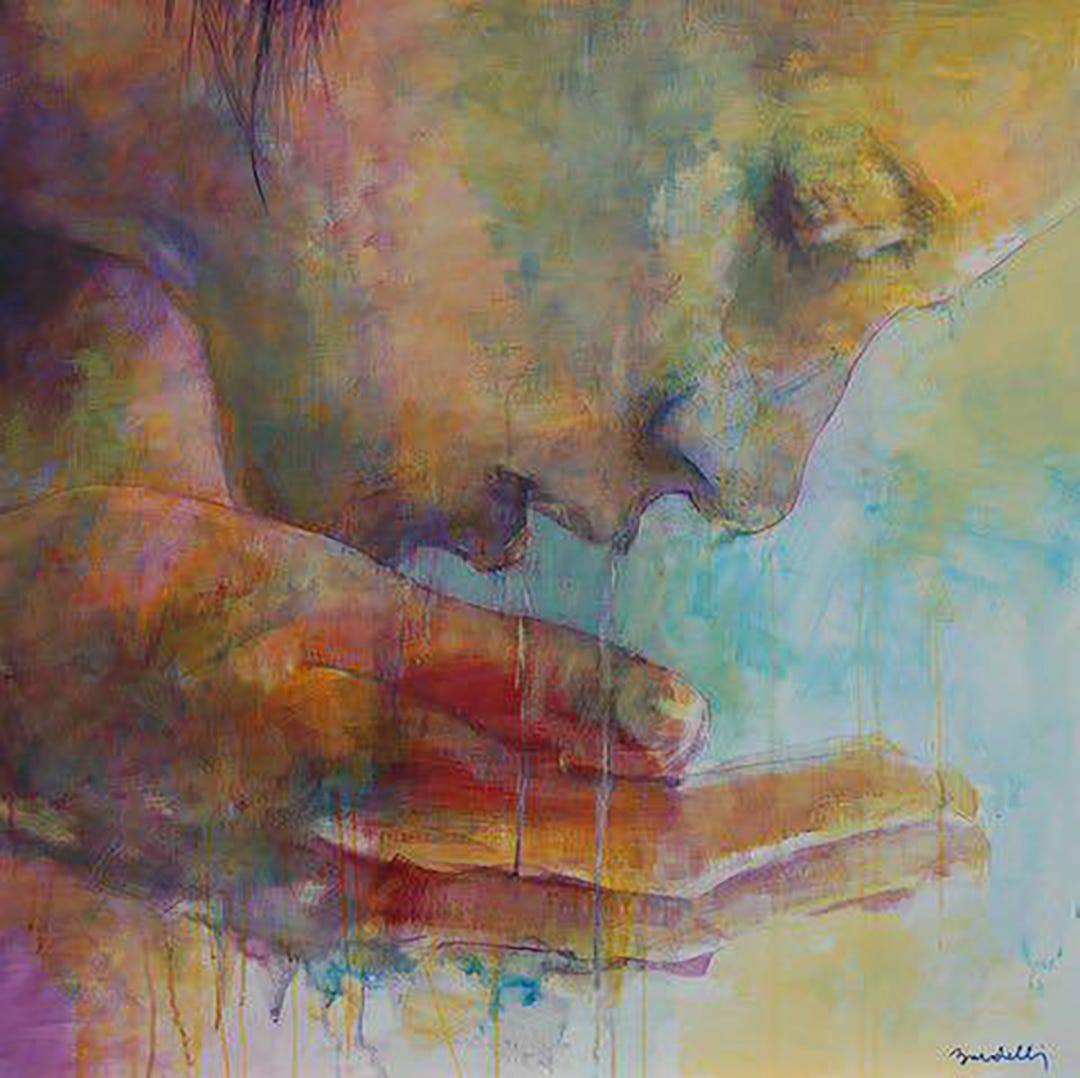
Every egg a woman will ever carry is already formed in her own ovaries while she is still a fetus, curled inside her mother’s womb. Which means your first cell did not begin in your mother’s body. It began in your grandmother’s: a single cell, inside your mother, while your mother was still curled inside her. Trace it back and it does not stop there. Egg inside daughter inside mother, unbroken, for as many generations as our species has existed.
This is the moving thread that holds all of humanity together. It does not run straight. It curls back through mother into grandmother and into every mother before her, one continuous spiraling of living tissue, energy, and awareness. Every human being who has ever stood on this earth, male or female, first took shape somewhere inside this ancient turning.
There is no comparable nesting for men. Sperm are produced continuously, puberty to death, but nothing is pre-formed and carried forward the way an egg already is: no three generations held at once inside one body, nothing like a spiraling lineage curled and waiting.
All of this is simply biology, not metaphor, even as it can also function as one. Let’s sit with it a moment before we go anywhere else, because the whole of what follows is really just this one fact refusing to stay contained, instead insisting that it be once again lived out at every larger scale we can rediscover, together.
We built a whole human civilization (its religions, its economies, its wars, its laws, the whole apparatus of what gets called History (which is really just his-story), on the premise that the male line is the one worth naming and defending, while the actual unbroken thread, the one doing the continuing, the weaving, the holding, was female the entire time.
Patriarchal genealogy is not a competing fact. It is not even a fact at all. It is merely a story men told and still tell each other about who owns what. The weaving network kept spiraling through its cracks the whole time, mostly unnamed, because what is real has never needed a name.
A concept like “health” arises only after disease comes along to argue with it. Matriarchy is the same. It had no name until patriarchy made one necessary. In reality there are no other sides, only what is, life unfolding. Not two, not one, just this.
Matriarchy has no opposite.
We need to be exact here, because it is where almost every conversation about this gets derailed before it even starts. Matriarchy is not a throne with the sexes swapped: women running the same one-dimensional hierarchies that men built, a costume change and nothing more. That confusion is patriarchy’s own best defense: if the only alternative available is domination by the other sex, then domination itself will never be questioned, and a few women becoming better men than men is what gets sold as liberation.
Masculine and feminine, as I use them here, name two motions rather than two populations: the going out, and the holding. Every person carries both, in some proportion, whatever body they were handed. So when this essay says the masculine flinched, or hardened, or refused to come home, it is not saying men did that and women did not. It is naming a movement that got stuck, and we are all still living inside the result.
Matriarchy cannot be built, designed, or legislated into being, because any blueprint would be drawn in the only language now available to us, which is the language of the thing we are trying to leave. You cannot build a story of liberation using the language of the prison.
You cannot sketch a spiral using a ruler. Matriarchy cannot ever be a plan. It is the original curvature of all things, the ground beneath every straight line ever drawn on top of it. Five thousand years of patriarchal insistence has not stopped its turning.
Genesis has been translated and retranslated by empire for thousands of years, each pass filtering its teachings further through whoever held power at the time. See through enough of that overlay and what was actually being pointed to starts to surface.
The Tree of Life is life understood as one whole, every part in relation to every other, nothing standing outside, above, or apart from anything else. The Tree of Knowledge of Good and Evil is the tree of naming: this is good, that is evil, this is mine, that is other. It is an attempt to sort the Whole into pieces small enough to hold, contain, control. The warning was never about obedience. It was about what happens once the sorted pieces start to feel more real than the Whole they were cut from.
Eating from that second tree is not a decision about difference. It is the decision that separation is real. Difference is real. So is change. No two turns of a spiral are the same, and this was never the problem. The problem is separation: cut off, standing apart from what has just been named, in order to rule it from some imagined elsewhere. That belief is the actual Fall. Not a woman. Not a piece of fruit. The Fall is a mind convincing itself it can stand outside the spiral it is part of.
A private conviction could stay private. This one doesn’t, because believing it changes nothing real: the mind that decides it stands apart is still fed by soil it didn’t make, still breathing air it doesn’t own, exactly as dependent as it was a moment before the belief arrived. Belief alone can’t make separation true. Only control can, or the appearance of it. So the conviction reaches outward, needing to be acted upon, out in the open. To become a Namer: someone positioned apart from the world for the sole purpose of defining it, sorting it, putting it to use. Naming, done in this way, was never about description. It was always appropriation with a straight face.
So here is one of the places patriarchy enters and begins to organize itself as the social norm. It is one instance, historical, gendered, of a delusion that will go on to wear a great many other costumes: race, class, empire, all of it downstream of the same original move, repeated over and over.
A man declares himself separate from the lineage that gave birth to him. The womb, which was always the whole, undivided, needing no other name, becomes in his mind a subject realm he now stands outside of, and can therefore own, control and administer. What is still whole nevertheless becomes mere bits and pieces in his own mind, available to be captured, divided, hoarded.
And yet this wound was never in the naming. Naming is how any awakening mind meets a world it is born into. The wound was in forgetting that the namer was never outside the spiral he named.
This wound has a shape that can still be found, faintly, in initiation traditions and rites of passage on every continent, however differently each culture played them out.
A boy is born of the womb-lineage, the center, the circle. At some point, through initiation, ordeal, or simply growing and going, he leaves, and through that leaving enters what elders once called the wilderness: the outside, the unknown, the place that tests and changes him. This departure was never the crime. It is part of the spiral’s own outward arc, how new strength and new information get generated and eventually folded back into a system that would otherwise just repeat itself around its own center forever. Every healthy spiral needs outward turnings. That was always the design: motion that leaves in order to return larger, and bring what it becomes back into the circle through a woman. Never motion for its own sake.
The crime, the wounding, when there is one, is what happens afterward, assuming he comes back at all. Some don’t; the wilderness keeps them.
But of the ones who return, transformed now into young men, here is the deviation that eventually becomes a crime against the Whole: he begins to take the leaving not as a passage but as the whole truth of who he is. He starts to believe that apartness itself is what makes him a man, rather than understanding it as one arc of a longer motion whose entire point was always the curve home. He hardens a necessary, temporary distance into a permanent identity. The gate that opened so he could discover his own part in Creation was never meant to be welded shut behind him, so that he could stand on his side of it and call that “strength.”
Here was the first stall, the first place the spiral began to seize into a flattened wheel that only knows how to spin in place.
There is a piece of biology that mirrors this so exactly it deserves to be sat with rather than rushed past. It is the egg, not only the sperm, that has a say. Fertilization is not simply a race that the fastest sperm wins by force; research in recent years has found that the egg, through the chemistry it gives off, has a hand in which sperm reach it and which one it lets through.
The male contributes potential. The female provides the context, the choosing, the place where potential becomes anything at all. That is not sentiment. It is what happens, cell by cell, every single time a human life begins, which means the male, the sperm, was never actually in charge to begin with. It only believed it was so, all the while standing outside a gate of its own imagining, welded shut, congratulating itself on a strength that was in the end only abandonment with better posture.
The healthy, completed shape of the male role was never domination. It was the return, and the necessary surrender folded into it. Not the surrender of defeat, but an offering: I went out, I was changed, and I bring what I became back to the circle that sent me, to be received or not, on the circle’s own terms.
Patriarchy is what happens when that offering gets permanently forgotten. The man standing on his own side of the welded gate chops down a forest, builds a permanent camp in the wilderness, and calls that civilization: no longer the womb, no longer the circle, no longer the spiraling fires of life discovering Herself. The line he draws from that camp outward, never once curving back, has become the actual architecture of humanity’s last five thousand years.
This is a trauma response rather than a plan. Somewhere very early, the masculine met the actual scale of what it came from (the womb, the earth, birth, death, cycles and spirals it could not control or even fully witness from inside its own small frame of time) and flinched.
Rather than remain in a coevolving relationship with something that large and that unmasterable, the masculine decided the only available safety was to define this vastness as other, as raw material, as nature, as female: categories it believed it could now stand outside of and manage.
Categories can be managed. They can also be discarded. This is why women still go missing. This is why the planet is treated the same way. Every subsequent structure of domination is downstream of that first flinch: I will not be small in the face of what made me. I will, instead, make it smaller than me. You can hear that same flinch, still going strong, underneath almost everything in our present world that calls itself strength.
Once the pattern sets (separate first, then manage what you have separated yourself from), it does not stay contained to gender. It becomes the operating system underneath everything else. This is also where the same move gets a new costume, over and over, and it is worth actually tracing the costumes rather than gesturing at them, because the repetition is the point.
The same millennia-long process happened in many places and in many ways all around the planet. This is the thread that began as one among many and became the one that dominated. Early European feudal aristocracies, after the partial retreat of the Roman empire and already deep in their own beliefs that some men stand closer to God than others, have their self-justifying theologies formalized by the Roman Church into an order of kings and popes, a hierarchy of ‘naming rights’ running straight down from heaven. Then a few centuries later the philosopher Descartes sits by his stove and decides that the ‘thinking self’ is the one sure thing, and everything else (the body, the earth, the animal, the feminine, and this whole warm world, unreasoning to him) is extension, possession, mere matter, mechanism. Res extensa standing apart from res cogitans.
Descartes actually believed he was overthrowing the Church’s authority. He was only handing the same old separation ideology and inbred identities a new set of clothes, moving the throne away from God’s right hand and into the thinking mind of Man. Every dualist since has kept furnishing that same throne room.
The merchant and banking classes picked the vocabulary up next and turned it into ‘capital’: land no longer commons but property, a person no longer a member of a place but a unit of labor, the whole living world converted, line by line, into ledger. Each handoff keeps insisting it is a revolution against the one before it. Yet each one is the identical move in merely a different accent, a revised set of symbols: stand apart, name what you see, own and control what you name.
Land that had been held collectively was enclosed. This did not happen everywhere at once; it built slowly in feudal Europe through the privatization of the commons, then accelerated past every local limit once industrialization and then fossil fuels gave the same old habit a planetary reach it had never had before.
Indigenous and matriarchal cultures persisted through most of human history in uneasy coexistence with empire’s spread, because empire kept running into the hard edges of its own logistics, and collapsing back. Fossil fuels, modern transport systems and industry removed that edge. There is no longer an elsewhere for a different way of living to quietly continue.
That is what makes this crisis read as planetary rather than regional, and it is new, genuinely new, in the whole history of the separation wound.
And here is a thing worth naming plainly, because it is easy to mistake all this frantic activity for movement, and it is not. A wheel spinning in place will throw off tremendous noise, tremendous heat, without ever arriving anywhere. That is also what accumulation is. Empire expanding its borders, capital compounding its returns, an economy measuring its own health by how fast it can seem to grow, with none of it going anywhere real, because none of it curves back through anything real, none of it brings what it has gathered home, to be received or refused by a living spiraling circle that can, by its very nature, change. Instead, it merely enlarges the same static position, spinning ever faster the more it keeps sensing that, somewhere underneath, it was never moving or changing at all.
Real Movement (the kind a living spiral makes, the kind evolution makes, the kind seashells and stars and suns and planets and galaxies make, and most especially the kind a life really lived makes) always curves back through its own source and comes out the other side changed.
Patriarchy’s whole visible history, the empires, the enclosures, the compounding fortunes, the wars fought to protect them, is a flattened wheel’s version of movement: constant, exhausting, and going nowhere, because true change and evolution were never part of any separation ideology’s design or intention, and can never be captured by one.
Only return was ever going to get anywhere, and return is the one motion all these flattened wheels of patriarchy and empire cannot ever make.
There is a second piece of biology here, and it is even less optional than the first. A body is not a thing. It is a place that matter passes through. Most of what you were made of a year ago has already left you, breathed out, shed, broken down and carried off, and you are still here, not because anything was held, but because the pattern kept taking in and giving back fast enough to go on being itself. A river is not the water in it. A flame is not the wax. Every living thing is a form that continues precisely by refusing to keep anything, and the moment the passing-through stops, so does the life. That is not a metaphor for what I have been describing. It is the literal mechanism, cell by cell, of being alive at all.
You are doing it right now, reading this. Out, and then back in. You cannot store a breath, cannot hoard one, cannot win by holding on to one, and the one you just gave away is already coming back to you changed. It is this whole essay, happening in your chest, some fifteen times a minute, and it has never once needed to be explained to you.
So return was never a recommendation. I am not asking men, or nations, or anyone at all, to be more generous than they feel like being. Return is the condition. It is what alive means. Whatever only gathers, only fences, only accumulates and never gives back, has not chosen a harder way of living. It is doing the thing that dying is.
The flattened wheel is not evil. It is dying, and has not yet noticed, and all that noise and heat it throws off is the sound of not noticing.
Scarcity, in most of the forms we actually live inside of now, is manufactured rather than natural. Indigenous and matriarchal responses to real shortage (drought, famine, hard winters) were overwhelmingly to share what was left, because a people who trust they have enough are nearly impossible to turn against each other.
Artificial scarcity, the kind that forces most people into competition over what a small class in actuality controls, is not a response to nature’s limits. It is the mechanism by which that class stays a ruling class. Division is the actual product now being sold at every level and every scale, corporate or autocratic, because a person still held by a tribe, a watershed, an extended family, an actual commons, carries resources and a belonging that never pass through ruling hands at all, and it also cannot be frightened nearly as easily.
So those bonds get broken, by economic pressure, by the enclosure of the commons of human language and communication, and with every sort of public media now additionally tuned by algorithms, all to keep people activated against each other, rather than joined to each other. Until division starts to look like human nature, instead of what it actually is: a very old and very successful strategy, run by the ones who believe they benefit from a flattened wheel that has convinced enough people to mistake its incessant spinning for progress.
I want to be careful here, because the same trap catches people who believe they have already seen through it, and I have watched it catch people I respect.
There is a whole family of responses to all this: women becoming better men than men in order to “win”; off-grid fortresses and exit strategies built to escape the wreckage; certain spiritual postures that claim to have transcended separation while still operating entirely out of fear and defense. These are strategies that look like an answer but are really the same wheel, spinning faster without ever moving, mistaking speed for departure.
Feminism that measures its success by how many women reach the top of hierarchies that were never questioned is of course not nothing (representation matters, access matters), but if the domination logic underneath the hierarchy goes unexamined, then putting different people at the top only changes who benefits, not what the structure does to everyone still below them. It is a bargain: some limited access, in trade for leaving the architecture standing. A woman in the general's chair, corporate feminism replacing corporate patriarchs, girlboss replacing boss: different filters over the same eyes, still deciding what gets seen, and always spinning the same wheel, just in a different color.
Or consider the counter-culture retreat: ten acres, a mutual-aid extended family, a parallel economy, and a sovereignty built specifically to escape a corrupted system. Genuinely useful, some of it. Yet notice the posture: defined entirely by what it is against, a fortress organized by its enemies as surely as if they had drawn the blueprints themselves. It is still attempting to solve a spiritual crisis, the belief in separation, with a material solution: better logistics, better defenses, a taller wall, better separation. Same flattened wheel, with some upgraded interface.
The billionaire’s bunker in New Zealand and the off-grid retreat share more architecture than either one would like to admit, because both were drawn by the same conviction that safety comes from separating yourself from what threatens you and controlling what remains: accumulation once again mistaken for arrival, just at a smaller, perhaps more sincere scale.
A test for telling a real alternative from a rebranded cage: does it still run on ownership, control, and exclusion, even in service of a cause you believe in? Does it gather, or does it also give back? If it only gathers, it will eventually reproduce the very thing it thought it escaped, because the beliefs underneath the strategies of separation are still not being touched. We can sometimes build beautiful things out of beliefs. We cannot build freedom out of beliefs, because freedom was never a belief to begin with. Freedom is the actual living spiral, moving according to its own nature, a motion the flattened wheel has never once managed.
Somewhere in here the argument has to stop circling at the level of history and myth and land on actual living ground, because that is where it either becomes real or stays a well-built, contrived idea.
I have spent large portions of my life in two small places (Gila, in the mountains of southwestern New Mexico, and now Talent, in the Rogue Valley of southern Oregon), and what I have learned in both, slowly, the way you learn a thing by failing at it repeatedly, is that none of this turns from an argument into a life until it has a place to happen in.
A watershed does not care what century’s theology built the fence across it. A community garden does not run on Cartesian boxes; it runs on who shows up, whose hands are actually in the dirt, and whether the water gets shared honestly when it runs short. Real change, if it comes, comes the way water comes down a mountain: locally, following the exact shape of the ground, curving around what it cannot move through, pooling, cutting a new channel when the old one silts up, not descending from some abstraction about ground in general. The Apache and the Gwich’in did not hold their worlds together with a philosophy. They held it together by staying in relationship with a specific river, a specific herd, a specific stretch of desert or ice, for longer than any single empire has ever managed to hold anything.
Indigenous and matriarchal ways of living were never primarily ideas. They were practices, rooted, repeated, taught hand to hand and word of mouth, which is exactly why they were so hard for empire to kill and yet so easy for empire to finally outrun, once it found ways to operate at a scale no single place could hold it accountable to.
This is the piece that gets lost when the whole argument stays at the level of Genesis and empire and five thousand years: return is not a feeling you arrive at by thinking hard enough. It is a set of real, local, unglamorous moments and movements (who grows your food, who you owe your attention to, which river you have agreed to answer to, which neighbor you show up for), and without that ground under it, everything said so far is still just a better-built version of the same abstraction the Namers have always specialized in.
The living circle was never an idea. It was a place people stood in, together, on purpose, more than once (not with the people they would have chosen, but with whoever was actually there), and stood in again the next season, and the one after that, and again when the first of them were dead and their children were standing in their places. That is the only way a real living spiral is able to arise: not declared, but walked, lived.
None of this turns through force, because force is the flattened wheel’s delusion, the same flinch now grown into a system: more of it only feeds the very thing that instead needs to stop and realize itself. Through return the wheel becomes, once again, the spiral it always was: a different motion than either surrender or conquest, closer to the real outward arc of a living spiral finally agreeing to curve back into itself, the flattened wheel finally cracking back open into the shape it was secretly trying to be all along.
For men, the actual work is not tending the fire harder or better, refining aggression into some more presentable version of itself. The whole world is already burning with that fire, the same fire that was once Her spiraling discovery of Herself, now loose and never brought back home. More of it is not the fix. What is needed is closer to water: grief let out into the open air, real confrontation between men that goes past bravado into the fear underneath it, the willingness to be changed rather than merely to win. And then the return itself: bringing back whatever got found out there, not as a gift for which the circle then owes someone, but instead as an offering the circle remains free to accept or refuse. None of that is a virtue to be acquired. It is only what the motion looks like when it is allowed to finish.
Go out far enough (fasting, alone, with nothing to prove and no one to fight) and it starts to fold into an inward discovery. The ones who go looking for an enemy come back with nothing. The ones who go looking for nothing sometimes come back changed. A warrior, in this older sense, returns with empty hands, not a weapon; his whole worth is measured by what he is willing to bring back and set down, not by how far away he manages to get.
For women, I do not think the first move is persuasion. Patriarchy has never responded well to being asked nicely, and it has absorbed a great deal of protest into itself as content, another product line, another way of keeping the wheel turning under a friendlier banner. The more effective move, historically and now, may be closer to withdrawal: collectively declining to keep supplying the labor, the attention, the consent, and the audience the current order depends on to keep functioning at all. This isn’t a tactic borrowed from politics. It’s the oldest gesture there is: the same selective power the egg has always had, deciding which one it lets through, now exercised at the scale of a whole society rather than a single cell.
There is a form of power here that does not need to match violence with more violence, which only ever produces more violence in return, more spin, more heat, the same flattened wheel accelerating toward whatever it fears is waiting for it at the end of acceleration.
I want to be exact about one more thing, because it is easy to flatten: defense is not domination. People protecting their homes, their children, their actual survival against invasion are not violating any of this by defending themselves; refusing to defend ourselves would be abdication, not wisdom. The critique here is of a permanent posture of defense then mistaken for an entire way of living, an identity built around what you are against rather than what you are for.
The many people now living openly outside patriarchy’s old categories are not a distraction from this argument. They are the same spiral, still turning, reminding the rest of us that our categories were always narrower than the reality generating them.
The spiral was never broken. It has only gone unmentioned, for a very long time, by the part of our species that walked the farthest away from it and then mistook their walking away for the whole of the journey. It is still there the way your first cell was always still there, curled inside your grandmother’s body before your mother was ever born, whether or not anyone in your family ever once said so out loud. The spiral of life runs on, regardless of who forgot to name it. The flattened wheel spins on too, louder every year, but a spinning wheel is not a rival to a spiral. It is merely what the spiral looks like when some part of it has forgotten that it is allowed to come back home.
And so what I keep returning to, underneath the history and the politics and the specific damage (the enclosures, the missing women, the poisoned rivers, a planet running out of runway) is something closer to plain fact than hope: nothing was ever actually separate, not from its source, and not from each other. Separation is not an evil that needs defeating. It is a belief, and beliefs, however old, however armored, however many generations they have had to compound and calcify, are not made of the same material as the thing they are beliefs about. Seen clearly enough, they do not need to be fought. They stop being believed, the way you stop fearing a shadow not because you defeated it but because the light came on and you finally see what it never was.
To paraphrase Richard Rohr, God loves us by becoming us. I have leaned on that line for years because it is one of the shortest true things I know, and because it describes exactly what a spiral does that a wheel never can: it doesn’t escape its own center by moving away from it, and it doesn’t just orbit its own center forever either. It becomes larger and larger simply by curving back through itself, again and again, every pass a little bit wider than the last, and each return carrying something the center did not have the last time it was touched.
That is Movement, the real kind, evolution and creation rather than mere accumulation, and it is what this whole essay has been trying to trace at every scale it can speak to: cellular, mythic, spiritual, historical, planetary.
This writing, in its own way, is attempting exactly that movement: a joining and rejoining with others.
We went out into all this analysis, all this naming, all this necessary trouble, and now we are carrying our journey back, like an ember, to offer it into the spiraling circle where it all began: the Gila, the Rogue Valley, or wherever ground is actually under you right now. Not a new direction. The oldest one there is, still moving, still turning, still, if we let it, becoming us.
~ John Fridinger
Summer, 2026
Talent, OR