Something is happening now that none of humanity’s accepted ways of talking and sharing and exchanging perspectives can hold.
Not because it hasn’t been named. It has been named, in thousands of reports and articles and warnings and calls to action, for decades. Named and named and named while the thing being named continued, unaltered, in the wrong direction. The naming has not been the problem. Something in the relationship between the naming and what is named — something in the spaces between all the words and the weight of what all the words are pointing at — has not connected. Has not landed. Has not moved through from mere words to the felt, from a collection of conceptual understandings to the acted upon, in that way current moves through an electrical conductor when a switch closes and the circuit is completed.
It is not a failure of information. The information exists, in quantities previous generations and previous civilizations could never have imagined. It is not a failure of intelligence. The people who understand what the instruments are measuring, who can read feedback loops and grasp the tipping cascades and recognize the gaps between the models and what the instruments actually find — these are not stupid people, and there are more of them, better equipped, than at any point in human history.
It is not even, finally, a failure of will, though it has felt like that, and been named as such, generating enormous self-reproach and condemnation in the people who care most.
It is something else. Something that sits beneath information and intelligence and will, and that none of those, deployed in isolation, have been able to reach.
There are three kinds of people who have been, to varying degrees, consciously living with this — not three kinds of people in total, but three ways of being alive to what is happening that tend to organize themselves into recognizable shapes in response to so many lives and communities and cultures and bioregions in extremis.
There are people who live in the data. Who read the WMO reports and the tipping point studies and the satellite records and the model comparisons, and who feel, in the presence of that data, something that is not quite fear and not quite grief but is adjacent to both — a kind of vertigo that comes from following the numbers honestly to where they go. These people trust measurement. They trust replication. They trust the patient accumulation of evidence that says: this is what is actually happening, regardless of what we wish was happening. That trust is not naivety. It is faithfulness — an embracing of the real, of what instruments find when they are pointed honestly at what they are measuring.
There are people who live in the political anatomy. Who see, in what is happening, not primarily a physical crisis but a crisis of power — who understand that the emissions driving the physical destabilization were not accidents, that the systems failing to respond are not failing randomly, that the forces blocking the response have names and addresses and quarterly earnings reports, and that understanding this machinery is the precondition for any honest account of how we arrived here. These people trust political and financial analysis. They trust the tracings of cause and consequence, the following of money and power and institutional interests to where they actually lead. That trust is also faithfulness — to accountability, to the refusal to let the authors of what is happening disappear into abstraction.
And there are people who live in a different register entirely — who have been sensing, for a long time, beneath the crisis and beneath the political anatomy of the crisis, something that the data and the analyses confirm yet was already known before any of the data and analyses arrived. Who have felt, in their bodies and in their practices and in a specific quality of attention when it settles into stillness, that what is happening in the world is not separate from something happening in consciousness — that the burning and the forgetting of our own humanity are related, that the enclosure of the land and the enclosure of the self is the same gesture, that what has been called the environmental crisis and what has been called the spiritual crisis of modernity are not two crises but one. These people trust a different kind of knowing. Not irrational — differently rational. Prior to argument. The kind of knowing that does not require proof because it is not a conclusion. It is a recognition.
What none of these three has been able to do, alone, is hold the full weight of what is actually happening.
The people in the data know what the instruments are measuring. What they cannot find, in the data alone, is the question that sits beneath the data: not what is happening, but what kind of thing this is. Whether it is a problem — something that arrived from outside a system we also see ourselves partly outside of, something that can be solved by sufficient application of the right tools — or something else. Something generated from inside. Something whose roots run deeper than any instrument has been designed to reach. Something we are also part of.
The people in the political anatomy know who built this and how and why. What they sometimes cannot find, in the political anatomy alone, is the ground beneath the machinery. The question of what kinds of belief — about what a human being is, what the world is, what the relationship between the two is — had to already be in place before any of the machinery could be built. Belief is older than its institutions. The belief driving all this is much older, and runs far deeper, than any analysis of its most recent expressions can reach.
The people in the contemplative register know, sense, perhaps have been living in the presence of, something the other two have been circling without naming. That the separation — of humans from nature, of self from world, of the knower from the known — is not merely an instrumental or political or economic arrangement. It is a story. The oldest available story. So deeply assumed that very early on it stopped being experienced as a story and became, instead, the shape of believed reality itself. Invisible in the same way water is invisible to fish.
But what is so often not found, in the contemplative register alone, is the full texture and weight — the real and actual scent — of what that story has produced in the physical world: the specific, measured, documented, irreversible consequences of a civilization that has been acting out a logic of separation on a planetary scale for five hundred years, with ever-increasing efficiency and force. What is sometimes called spiritual bypassing — the drift into a spaciousness that dissolves the weight of the burning rather than holding it — is not a failure of sincerity. It is what happens when the ground beneath all crisis is touched, yet the crisis is released too soon. As though stillness could be captured. As though the fire could be left outside.
Each of these three knows something the others need. Not as supplement — as deeper and deepening ground. The data needs the political anatomy to understand who has been reading it and what they have been concluding. The political anatomy needs the contemplative ground to understand what makes the ruling class calculus feel not like choices being made but like the nature of things. The contemplative ground needs the data and the political anatomy to stay honest — to remain connected to the specific, physical, irreversible consequences of the story it is pointing beneath.
Belief and political machinery did not arrive in a clean sequence — belief first, then structures enacting it. That is too simple, and too easy on the structures. What actually happened, and what has been happening across the ten thousand years since the first surplus grain was held by the few and the first commons was enclosed and the first body was owned — is a spiraling loop. Belief produced machinery in its image. Machinery reproduced belief. Each generation inherits a world already shaped by the logic of prior separation, and experiences that shape not as a choice their ancestors made but as the nature of things. As reality itself. As the floor they are building upon, floor after floor after floor.
A belief you can argue with. A thousand floors feel like one whole world that you stand on without ever knowing it is all there.
The loop did not stay the same size. It became ever more efficient and ever more ruthless, extending its reach — from the tribe to the village commons to the continent, from the continents to the hemispheres, from the hemispheres to planetary systems that are not part of any economy and have therefore, within the logic of the loop, no value until they are converted into resources for it. The atmosphere. The ocean chemistry. The soil that took ten thousand years to become what it is. The living networks — mycorrhizal, oceanic, atmospheric — that have been maintaining the conditions for life on this planet since long before the first human looked out at the horizon and began, for reasons we will never fully know, to believe that what was out there was separate from what was in here.
That loop has now reached the only scale that remains. There is no more outside. The planetary commons is the last commons. And the logic that has been enclosing commons for ten thousand years is doing to it what it has done to everything else: extracting, externalizing the cost, positioning “above” the consequence, and administering an increasingly diminishing remainder.
The remainder, in this case, being the actual conditions for life on Earth.
There is a particular kind of person this moment is asking for.
Not a hero. The hero narrative is part of the mythology that produced the crisis — the single figure who stands above the situation, sees it whole, and through force or willfulness or genius or moral superiority turns the tide. That narrative requires an artificial separation between the one who acts and the situation acted upon. It requires an above and a below, a higher and a lower. The recognition this moment is pressing toward, at an exponentially increasing rate, is precisely that there is no above, no below. There is only within.
Not a saint. The saint narrative makes the same error from the other direction — the one who has transcended the situation, who moves through the burning world untouched by the burning. That untouchedness is not enlightenment. It is dissociation. What the moment is asking for is not people who are no longer hurt by what is happening. It is people who are hurt by it in the right way — accurately, proportionately, with the specific quality of grief that knows what it is grieving and does not confuse necessary grief with defeat.
Not an expert. Expertise, in the forms institutional civilization has developed it into, is just another form of separation — the parceling of knowing into separate domains with walls between them, each domain speaking its own language, each translation slightly lossier than the last, no full picture assembling in any single room.
The crisis does not respect walls. The atmosphere does not know it is crossing from a climate scientist’s domain to a political economist’s to a contemplative practitioner’s. It is one atmosphere. What is being asked for is a knowing willing to be just as whole as what it is trying to know. Willing, not willful. Willful holds a boundary around itself. Willing does not.
What is being asked for — and what has always existed, in every time, at the edges of whatever system was failing — is the person who can hold the data and the political anatomy and the contemplative ground simultaneously. Not as a synthesis achieved through effort. Not as an intellectual position carefully constructed to include all three. As a way of being alive to what is happening that was always, underneath the specializations and the separations, the actual texture of simple honest human attention.
These people are not rare in the way that heroes and saints are rare. They are numerous — more numerous than the current official conversation would suggest, because the official conversation is not designed to reach them or reflect them or confirm what they have been carrying. They exist in the gaps between the official categories. The scientist who meditates and does not know how to say so in a paper. The activist whose rage is underwritten by something quieter and more durable than rage, something they might call love if the word weren’t so easily misunderstood. The contemplative practitioner who reads the climate reports and feels them land not as information but as confirmation of something already known in the body, already felt in the quality of the air, already present in the specific sadness that has been there for years without a name proportionate to its weight.
They have been, in many cases, lonely in a particular way. The loneliness of people who cannot find, in any single conversation, the whole of what they know. Who have learned to speak differently in different rooms — the data language in one, the political language in another, the contemplative language in a third — because no room has yet been built large enough to hold all three at once without someone being asked to be quiet, or to translate themselves into the terms of others, or to wait outside, never quite coming in.
What follows was written for that loneliness.
Not to resolve it — loneliness of that kind is not a problem to be solved but a signal to be read, a path to be followed. Instead to confirm it. To say: what you have been carrying in pieces, across different rooms and different languages and different moments of your life, is one whole thing. Has always been one whole thing. And there is a place where all of it can be spoken at once — where the data and the political anatomy and the contemplative ground are not three concerns requiring translation between them but three instruments playing the same piece.
This place is not a theory. Not a framework, or a position, or a school of thought. It is, if anything, a direction — the direction you are already facing when you have followed any one of the three orientations honestly enough, and far enough. Past the point where it can sustain itself alone.
The data, followed honestly past the point where reassurance is possible, arrives at a question it cannot answer with more data: what kind of thing is this, finally, and what does it ask of the one who knows it?
The political anatomy, followed honestly past the point where naming the machinery is sufficient, arrives at a question it cannot answer with more analysis: what is the ground beneath this machinery, and what are the beliefs that made the machinery feel, to the people building it, not like a choice but like the nature of things?
The contemplative ground, followed honestly past the point where spaciousness alone can hold what is happening, arrives at a question it cannot answer with more stillness: what does this recognition — that the separation was always pretense, that the ground was never absent — actually require of a person living in an actual body, in an actual time, in a world where the consequences of the pretense are now physical and measurable and in so many cases irreversible?
Each of the three, followed all the way down, arrives at the same threshold. Not the same answer — there is no single answer, and any writing that offers one should be read with suspicion. The same threshold. The place where the question opens into something that is not quite a question anymore. Where knowing and what is felt and the ground beneath it all begin, tentatively, to move toward and into each other.
This is not a comfortable place. It was never meant to be. The comfort available here is not the comfort of resolution but the comfort of company — the specific relief of finding that what you have been carrying is real, that others have been carrying it too, that the weight is not a sign of weakness or oversensitivity or lack of faith in human ingenuity, or an excess of it. The weight is simply proportionate. The accurate response of a person who has not looked away.
What comes next is for the person who is living, in whatever incomplete or partial combination, in all three of these registers. Who feels the data landing in the body as more than information. Who feels the political anatomy as more than outrage. Who feels the contemplative ground as much more than retreat.
It was written, finally, for the loneliness that knows, before it has read a word of what follows, that it is not — has never been — alone in what it carries.
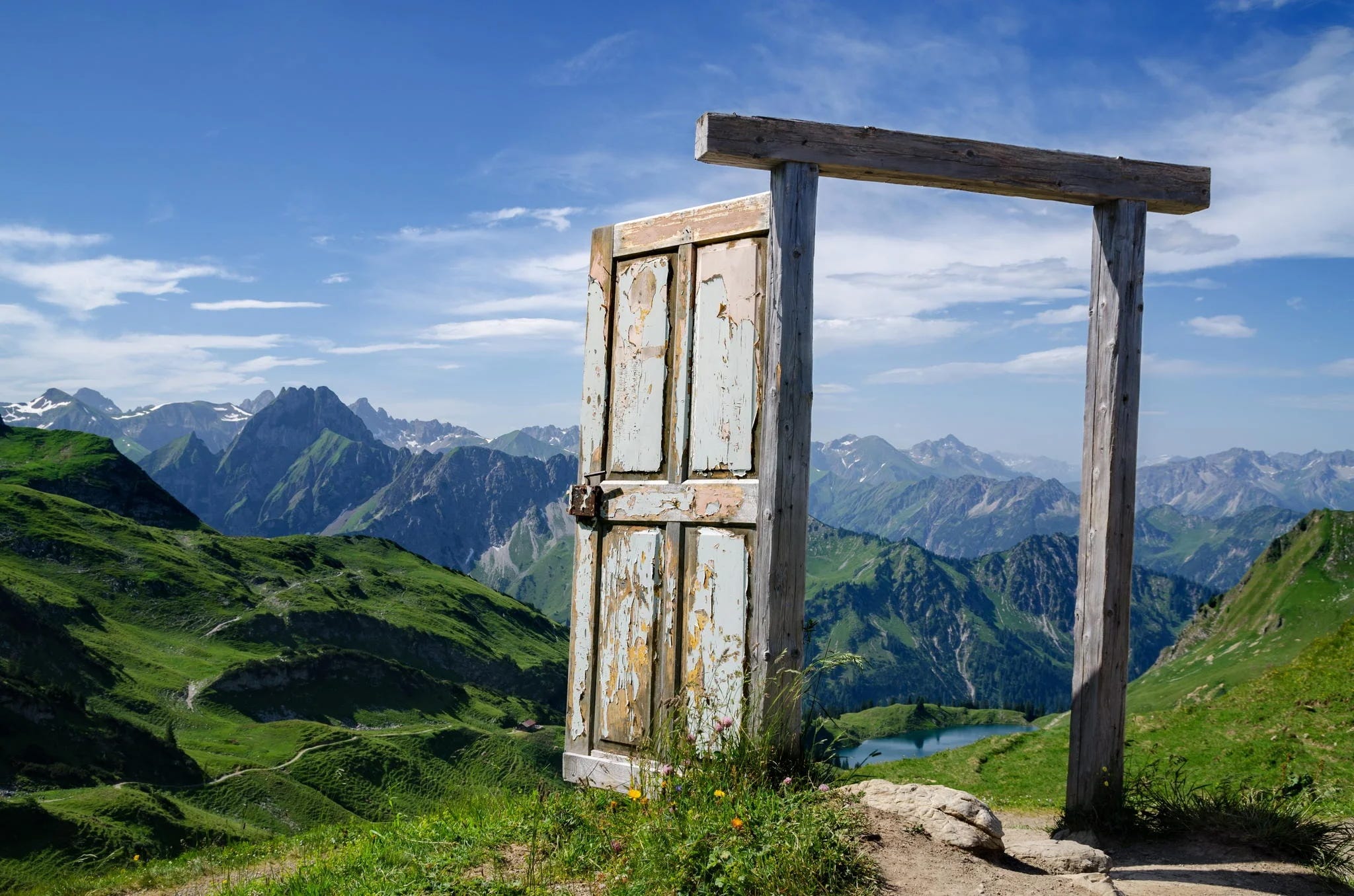
Here is the door.
The Ground Beneath the Emergency is on the other side.
~ John Fridinger
Summer, 2026
Talent, OR


