

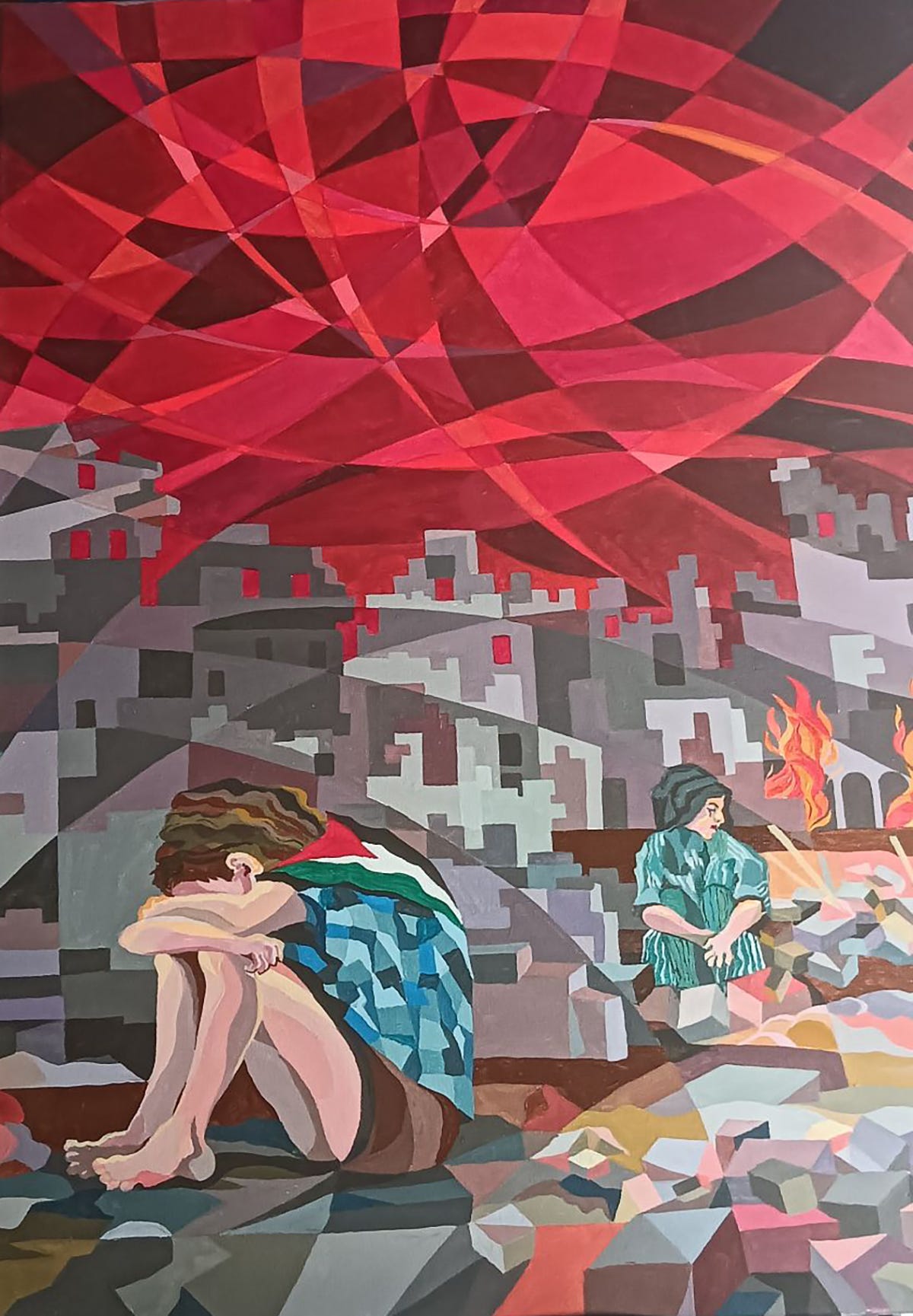
Something is becoming visible, if you can hold still long enough to see it.
Not a conspiracy. Not a plan in the blueprint sense, with architects and meeting minutes and a signed agreement. Something more impersonal than that, and in some ways more dangerous: a structural dynamic, a convergence of interests and technologies arriving at the same destination from different directions. A logic that has found its tools.
Here it is plainly:
Chaos is no longer the enemy of control. At sufficient technological scale, chaos has become the medium of control.
This is the inversion that changes everything — and that most political analysis still cannot absorb, because it’s still operating on an Enlightenment assumption that has quietly stopped being true. The assumption: that more information, more transparency, more participation moves a society toward better collective judgment. That democracy’s vulnerabilities are primarily about information scarcity — people not knowing enough, not having access enough, not being heard enough.
That assumption held when scarcity was the bottleneck.
It breaks completely when the information environment stops being scarce and becomes instead a flood — when the problem is no longer too little to know, but the deliberate manufacture of too much, too fast, too contradictory, too emotionally loaded to process. When attention itself becomes the scarce resource. When the capacity to form a coherent picture of reality — to think a thought through to its conclusion, to hold cause and effect together long enough to act on them — becomes the thing that is targeted and systematically destroyed.
What the powerful have always understood — in every era, in every empire — is that a confused and divided population is easier to manage than a coherent one. This is not new knowledge. What is new — what is categorically, qualitatively new — is the precision and scale of the delivery system now available for that ancient purpose.
A research paper published in Science in January 2026 by twenty-two scholars introduced the phrase “malicious AI swarms” — networks of AI-controlled agents, each with its own persistent identity and memory, coordinating across platforms, adapting to human responses in real time, manufacturing the appearance of social consensus from nothing. Not crude bots. Not copy-paste propaganda. Systems capable of joining your local Facebook group as a concerned parent, a veteran, a small business owner — spending weeks building trust and relationships — then seeding targeted doubt, amplifying division, harassing organizers, and moving on.
A single operator. Thousands of simultaneous personas. Never sleeping. Self-optimizing on engagement data. Indistinguishable, without specialized detection technology, from your actual neighbors.
This is not hypothetical. It is operational. Documented in at least fifty countries. Running in the 2026 US primary season right now — deepfake videos in the New York City mayoral race, AI-generated attack ads in Senate primaries, synthetic avatars deployed by AIPAC-aligned PACs against critics of Israeli policy.
Alongside the swarms: more than 1,200 "pink slime" fake local news websites — named for the meat industry filler engineered to pass as the real thing — now outnumbering actual daily newspapers in the United States — funded by dark money, oil and gas fortunes, conservative PACs, presenting themselves as neutral community journalism while functioning as targeted influence operations. The US Postal Service being weaponized to make mail ballot delivery conditional on states surrendering voter lists. The dismantling of every federal institution built after 2016 to detect and respond to exactly these threats. Ocean monitoring arrays pulled from the water. Cybersecurity infrastructure defunded. The architecture of collective knowing, systematically and deliberately demolished.
While the tools for manufacturing unreality scale exponentially upward.
Hannah Arendt named the destination long before these tools existed to reach it. Writing about totalitarianism, she observed that its ultimate aim was not to replace truth with lies — that would still leave the category of truth intact, still leave people oriented toward something real. The deeper aim was to destroy the capacity to tell the difference. To produce, as she wrote, a population for whom “the distinction between fact and fiction, true and false, no longer exists.”
Not believers in the regime’s lies. Not even cynics who disbelieve everything. People who have simply lost the orientation — who can no longer find the ground beneath their feet — and who therefore cannot organize, cannot sustain solidarity, cannot maintain the cognitive and emotional continuity that effective resistance requires.
A population in that condition retreats. Into tribal enclaves. Into entertainment and numbness. Into rage that burns hot and goes nowhere. Into the private, the local, the immediately manageable.
All of which is, from the perspective of those engineering the conditions, entirely acceptable. None of it threatens the architecture.
The chaos doesn’t need to resolve into any particular belief. It just needs to prevent coherence. And it’s working.
But here is what I want to say that almost no one else writing political analysis is saying — because it requires standing somewhere different to see it.
The people driving this — the oligarchs, the extraction industries, the technology platforms optimizing for engagement regardless of what that engagement is doing to human minds and social fabric, the political operatives weaponizing every available tool against the populations they nominally serve — are not, despite appearances, operating from a position of genuine power.
They are operating from a specific condition of consciousness. One that has forgotten its own ground. That experiences itself as fundamentally, irreducibly separate — from the living systems it extracts from, from the populations it manipulates, from the consequences of its own actions returning, as they always do, as they must.
This is not metaphor. Separated consciousness — consciousness that has lost the felt recognition of its own seamless participation in the whole — behaves in ways that are structurally indistinguishable from what we are watching: it maximizes at the expense of the system it depends on; it cannot recognize feedback as information about itself; it experiences its own lostness as clarity and its compulsions as strategy.
The oligarchy building surveillance infrastructure over a dying biosphere, manufacturing chaos in populations it depends on, is not doing this from a position of actual knowledge about what it is doing or where it leads. It is doing it from a particularly dangerous and extreme form of lostness — one that happens, at this precise historical moment, to have access to tools of extraordinary reach and power.
Previous expressions of this same separated consciousness — every empire, every extractive elite in history — eventually encountered the limits of their tools. And critically: the limits of their reach. Rome destroying itself destroyed Rome, and the provinces Rome had poisoned, and the peoples Rome had enslaved — but the Amazon still breathed. The oceans still regulated. The planetary systems that make complex life possible continued their ancient work, indifferent to the latest human catastrophe, ready to absorb and eventually outlast it.
That limit no longer exists.
Sometime in the last century — and we can argue the precise moment, but not the fact — humanity crossed a threshold. We stopped being one species among millions, coevolving with the living systems of this planet, subject to their larger rhythms and constraints. We became instead the dominant condition that all other life must now adapt to, or perish. Our chemistry in every ocean. Our heat signature altering every weather system. Our noise, our light, our waste, our appetite — woven now into the evolutionary pressures bearing on every living thing on earth.
The tools available to this particular expression of separated consciousness are of a different order than anything that came before. The feedback loops are faster, the reach is genuinely planetary, the self-optimizing systems operate at speeds no human oversight can match. And for the first time in the long history of elite predation, there is no intact planetary commons left to absorb the wreckage when this, too, collapses.
That is what makes this moment unlike any previous crisis of empire or extraction. Not the greed — that’s ancient. Not the ruthlessness — ancient too. The unprecedented thing is this: separated consciousness, with planetary reach, and no outside left to recover in.
So what do we do with clear seeing, when what is seen is this?
Not despair. Despair is just another form of the disorientation they’re engineering — the conclusion that nothing is real and nothing matters, which produces the same paralysis as manufactured chaos, just arrived at through different means.
Not naïve hope either — the kind that insists things will work out, that democracy is resilient, that institutions will hold, that we’ve been through worse. We haven’t been through this. This is a different order of thing entirely — which means its possibilities, including the ones we cannot yet see or name, are also of a different order.
What we can do — what I think is the actual work of this moment — is refuse the disorientation. Name what is happening as precisely as possible, as often as necessary, to as many people as can hear it. Not because naming alone is enough. But because coherence itself is the resistance. The capacity to see clearly, to think in connected ways, to maintain the thread between cause and effect and consequence and responsibility — this is what the whole system is engineered to destroy.
Every person who can hold that thread, who can say clearly this is what is happening and here is why and here is who benefits — every such person is a node of resistance that the swarms cannot easily replicate, because what they’re replicating is the appearance of human presence without the ground of it.
And yet that different order — the very thing that makes this moment so dangerous, so unlike anything in the long catalogue of human crises — also means something else. Something that doesn’t show up in the standard political analysis, in the alarm and the outrage and the urgent fundraising emails. When something is of a genuinely different order, its possibilities are also of a different order. Not more of what we’ve seen before, not a bigger version of what resistance has looked like in previous eras. Something that cannot yet be fully named, because it hasn’t fully arrived. But whose outlines are becoming visible, for those willing to look at the whole of what is happening rather than just the parts that frighten us.
Separated consciousness, pressed to its planetary limit, is producing conditions that make the fact of interconnection impossible to deny — in the climate, in the economy, in the information environment, in the body politic. You cannot manufacture this much chaos without eventually making the hidden wholeness visible by contrast.
This is not optimism. It is a structural observation. The lie of separateness is being exposed by the consequences of living it out to its logical end. What emerges from that exposure — recognition and reorientation, or deeper collapse — we cannot yet know. But the opening is real.
Which means the possibilities available in this moment are not the possibilities of incremental reform or managed decline. They are the possibilities that only appear when something fundamental is being forced to the surface. Possibilities that cannot be planned for, only met — with clarity, with presence, with the willingness to see what is actually here rather than what we expected or feared.
People ask me: what can we do?
It’s the right question, asked from the right place.
Here is what I find myself saying:
The global architecture of control — the AI swarms, the surveillance infrastructure, the weaponized platforms, the captured institutions — is not designed to manage your neighborhood. It is designed to manage populations at scale. And at scale is precisely where it is most effective, most overwhelming, most capable of manufacturing the feeling that nothing any individual or community does can matter.
But scale is not where life actually lives. Life lives locally. Always has.
Yes — the local. The same place people retreat to in defeat can become, when entered consciously, the ground where something real takes root. The difference is not the place. It is the quality of presence brought to it.
This doesn’t mean retreating from the larger picture. That looking is itself part of the work. It means recognizing that the larger picture is composed entirely of local realities, local relationships, local acts of coherence and care and truthfulness — and that these are exactly what the architecture of chaos cannot easily reach or replicate.
Not solutions. Seeds.
The distinction matters enormously. Solutions imply a plan, a timeline, a measurable outcome, a return to something resembling what we had before. Seeds imply something different: that what grows cannot be predetermined, that the grower neither controls nor needs to imagine the full form of what will emerge, that the work is simply to carry the living thing and place it in ground that can receive it.
What are the seeds? Honest conversation with your actual neighbors. Local food. Local exchange. Communities of mutual aid that don’t depend on platforms that can be weaponized or institutions that can be captured. The rebuilding — slowly, quietly, without waiting for permission — of the tissue of shared life that makes a population resilient rather than merely reactive.
And this: the seed of a different relationship to reality itself. People who have come through to the other side of the disorientation — who can no longer be easily manipulated because they have found something in themselves that the manipulation cannot reach — these people are themselves seeds. Not because of what they do, necessarily. Because of what they carry. Because of what becomes possible in their presence.
Some seeds don’t survive. That is the nature of seeds. But life has been placing seeds in the ground for hundreds of millions of years, and some always do. Through every previous extinction. Through every collapse of every civilization that believed itself permanent.
My faith — and I use that word deliberately, knowing what it means and what it doesn’t — is not that this particular civilization will be saved, or that the people now engineering its destruction will be stopped in time, or that the outcome is anything I can see from here.
My faith is in the resilience of life and consciousness themselves. In the fact that awareness, pressed to its limit, tends to wake up. That the very intensity of this moment is forcing a clarity that comfort never could. That seeds are already in the ground, already carrying what the next thing will need — even if neither the seeds nor anyone watching can yet imagine what grows.
The ground of it is what we’re standing on, when we’re standing anywhere real at all.
That ground — the awareness that knows itself as awareness, that cannot be manufactured or optimized or weaponized because it is what is prior to all of that — is not in danger.
But everything that grows from it, in this world, at this time, needs tending.
With eyes open.
With whatever clarity we can bring.
Now.
~ John Fridinger
Summer, 2026
Talent, OR
Thank you for bringing to the written page wisps of ideas and awareness that have been bubbling up for me.
588688
Consciousness the golden thread